Saturday, March 26, 2016

Irish Independence

Listen to a podcast of this episode.

World War I changed the map of Europe in many ways. It had a particular impact on Ireland.  One hundred years ago, the Irish Easter Revolt of 1916 struck a blow for independence.  It was a key event in the eventual creation of an independent Irish Republic.

Easter Uprising Proclamation
To understand the Irish independence movement, it is important to remember its origin.  Ireland had been under the control of Britain since the 12th Century when the Normans, who had completed their conquest of England, moved into Ireland to take control there as well.  In the Centuries that followed, however, Ireland went through periods of relative independence when England essentially ignored them, to periods of invasion and control when the English feared they might pose a threat to British control.  Ireland had its own parliament, but was controlled by the Lord Deputy of Ireland, appointed by the King of England.  The Irish paid taxes and tribute to English rulers.

In the 1500's King Henry VIII and his successors engaged in a concerted effort to bring Ireland under greater control of England.  Several decades of warfare finally resulted in the "flight of the Earls" when Irish lords finally fled the island for Europe after being defeated by English forces.

The English attempted to force changes that the Irish violently resisted.  England's attempts to convert the Irish from Catholicism to Protestantism created schisms that continue to this day. England also engaged in mass colonization, bringing in Scottish and English colonists, who settled primarily in northern Ireland, to exert better control. Only Protestants could serve in the Irish Parliament, and only land owning males could vote. Oliver Cromwell seized all land owned by Catholics and gave it to Protestant nobility.  As a result, the Irish people had no real say in their own government.

Catholics could not inherit property, bear arms, or serve in any government position, including the army.  They remained under English control for centuries, suffering this unjust and degrading second class citizenship.  Occasionally rebellions would break out, but English military might could not be overcome.  A major rebellion in 1798 resulted in the "Act of Union" which dissolved the Irish Parliament and merged Ireland into the United Kingdom, entirely under the control of the British Parliament.

Despite becoming a part of the UK, the Irish people remained either abused or neglected by the British government.  When the Irish Potato Famine began in the 1840's, Britain simply allowed millions of peasants to starve to death, literally.  No significant food or assistance was offered as people died with nothing to eat.  In fact much of the food that did grow in Ireland during this time was exported to England as the Irish people had no money to buy it.  Grain tariffs remained in place, making imported bread too expensive for most commoners. The population of Ireland dropped from over 6.5 million to just over three million over the next few decades as the Irish people either died or fled the country.

The result of this passive genocide was a renewed call for Irish political reform, to create a government of, by, and for the people.  In the late 1800's a powerful home rule movement began to grow in Ireland.  Several home rule bills were proposed and defeated.  The Irish grew more radicalized over time as they saw legislative reform was impossible.

Not all Irish wanted home rule.  A Home Rule Bill in 1912 inspired the creation of the first modern paramilitary organization in Ireland, the Ulster Volunteers.  Ironically this was a group of Northern Irish Protestants who opposed home rule.  They had no desire to fall under the control of the Irish Catholics whom they had oppressed for so many centuries.  The Catholics in response created the Irish Nationals and the Irish Republican Brotherhood.  The country seemed to be gearing up for a civil war after the Home Rule Bill passed.  Then, in 1914, WWI began and home rule was delayed for the duration of the war.

For Irish Republicans, this delay was unacceptable.  Not only did they continue to live under oppressive English rule, but Irish were being conscripted into the British Army to go fight a war in Europe.  Some Irish Republicans met the the German government, encouraging a German invasion of Ireland, or at least providing assistance to Irish resistance against England.  The British navy sank a German U-Boat attempting to deliver arms and ammunition to the rebels, just days before the Easter uprising was scheduled to begin.  The planned uprising for Easter Sunday was delayed a day until Monday.

Street fighting during the Easter Uprising.
On Monday, however, 1200 men attempted to secure key locations around Dublin.  Several other cities also participated in coordinated attacks. Soldiers, police, rebels, and civilians were killed during the fighting over the following week.

The British reaction was overwhelming and brutal.  More than 16,000 troops were rushed to the area.  British soldiers invaded homes and bayoneted civilians and rebels alike.  Several pro-republican activists who had no role in the uprising were summarily executed under the orders of British officers.  Artillery was used to demolish parts of Dublin, killing many civilians.  Under modern standards, all of these actions would be considered war crimes.  At this time, however, no punishment or even criticism was expressed by the British government.

Dublin's devastation following the British suppression
Overall about 500 people died and another 2200 were wounded.  The majority of dead and wounded were civilians, with no involvement in the fighting.  After the fighting had ended, British retribution remained just as brutal. Within weeks, 90 men were tried by military courts martial, sentenced to death, and executed by firing squad.  More than 3500 people were arrested and detained, either without trial or by summary military trial. Roughly 1500 of those were held longer term in internment camps, many without any proof of their participation in the rebellion.  Many were held simply because of their stated Republican beliefs, which were deemed to constitute a danger.

The British crack down only increased political support for independence.  The following year, the Sinn Fein party was created, and went on to landslide victories in the Parliamentary elections of 1918.  Finally, in 1922, the British permitted Ireland to form the Irish Free Republic, which covered most of the Island, other than the section of Northern Ireland dominated by the decedents of Protestant colonists.  That area remains part of Britain and remains a source of contention to this day.

Ireland today remembers 1916 the same way Americans remember 1776. It was the year that the modern fight for Irish Independence began.  Although the fight would take several years, the actions of the 1916 Easter Uprising were critical to its ultimate success.

Listen to a podcast of this episode.

Further Reading:

http://www.theirishstory.com/2012/09/18/the-irish-war-of-independence-a-brief-overview

http://www.bbc.co.uk/history/british/easterrising/prelude/index.shtml

http://www.historylearningsite.co.uk/ireland-1845-to-1922/the-1916-easter-rising/

http://www.telegraph.co.uk/news/worldnews/europe/ireland/12200216/What-was-the-Irelands-Easter-Rising-in-1916-Easter-Rebellion-armed-insurrection.html

http://www.irishcentral.com/roots/history/An-guide-to-the-historical-figures-and-moments-of-the-1916-Easter-Rising.html

If you would like a full book on the topic, I recommend 1916: The Easter Rising Paperback by Tim Pat Coogan (2005).

Saturday, March 12, 2016

Meet Bill Hitler, US Navy

Listen to a podcast of this episode.

It's tough to have a family name like Hitler.  Association with one of the most hated and despised names in modern history cannot be easy.  But that was the situation that William Patrick Hitler had to endure during WWII.

William Hitler
William did more than simply share a surname with Adolf Hitler.  Adolf was the boy's uncle.   Adolf's half-brother Alois fathered the child in England in 1911.  Alois abandoned the family a few years later.  William's British mother raised him as a normal British child.  He had no contact with his father or anyone else in the Hitler family while growing up.  In fact, his mother had been told that his father was dead, which she believed for many years.

When William was a teenager, he found out his father was still alive. Naturally curious to learn more about his father, he went to visit him in Germany in 1929.  He visited several more times over the next couple of years, attending a Nazi rally and meeting his Uncle Adolf.

In hindsight, it is easy to be critical of the boy's association with the Nazis. But at this time, Adolf Hitler was simply the leader of an extremist political organization.  He was not yet guilty of the crimes against humanity that he would commit a decade later. Back in England, William wrote several articles about his Uncle. While not yet a war criminal, the British people saw Adolf Hitler as a threat.  William's association caused him to lose his job in Britain and made it impossible for him to find another.

William Hitler with mother
NYC, 1939
Rejected by the country of his birth, William decided to move to Germany, where his association with the up and coming political leader might benefit him.  He worked in Berlin for a bank and later a car company in the early 1930's.  Uncle Adolf, however, saw the boy as a threat.  He seemed to have divided loyalties between Britain and Germany and also seem to enjoy discussing his uncle's embarrassing family history.

Adolf did not want a close family member making trouble.  Government officials kept a watch on William.  Several times, he was summoned to speak with his Uncle Adolf, who berated him and made his life generally miserable.  There is some evidence that William tried to threaten his Uncle by revealing family secrets, which if true would have made their relationship even worse.

In 1936, William decided to cut his ties with Hitler and Germany and move back to Britain.  Anti-Hitler sentiment in Britain had only gotten worse in the intervening years.  To prove his loyalty, William attempted to join the British military.  He was, however, rejected due to his relationship to Adolf Hitler.  William decided he would never really have acceptance in either Germany or Britain. In 1939, he decided to move to America and make a life for himself there.

In America, William did not try to hide his relationship to Adolf Hitler. Instead, he tried to build a career out of it.  He began a lecture tour in the US, sponsored by William Randolph Hearst discussing the dangers of the Nazis.  In 1939, He published a lengthy article in Look magazine entitled "Why I Hate My Uncle" which tried to awaken the American people to the growing Nazi menace.

William also tried to join the US military.  But for some reason, recruiters questioned whether William Hitler, a recent German immigrant, might pose a security risk. His applications were rejected.  Eventually after the war began, William wrote directly to President Roosevelt, begging to be allowed to fight. The White House referred the application to the FBI for investigation.  After, several years of investigation J. Edger Hoover, gave approval and William Hitler enlisted in the US Navy.

In March 1944, William Hitler joined the US Navy in New York City.  He served for three years as a pharmacist's mate, even receiving a Purple Heart for a minor injury.   He served honorably but relatively obscurely until his discharge in 1947.

Despite his loyal service, the Hitler surname only continued to cause him trouble.  He decided finally to change his name to William Stuart-Houston.  It is not clear why he chose that name, but it is clear why he wanted the change.  The name change allowed William to live a life of quiet anonymity.  He married a German born American wife and had four children.  He settled into a home on Long Island and lived a normal life until his death in 1987.

None of his four children had children of their own, bringing the family line of Hitlers in America to an end.

Listen to a podcast of this episode.

Further Reading:

http://www.americainwwii.com/articles/corpsman-hitler-us-navy

http://www.todayifoundout.com/index.php/2011/06/adolf-hitler-had-a-british-nephew-who-joined-the-u-s-navy-during-wwii

http://www.nytimes.com/2006/04/24/nyregion/24patchogue.html?_r=1&


Saturday, February 27, 2016

Malcolm X meeting with the KKK

Listen to a podcast of this episode.

Malcolm X remains a controversial figure in the civil rights movement.  Many see him as an early promoter of black pride, as a men who encouraged African-Americans to stand up for their rights and fight the injustices imposed by the white majority.  He is remembered as being more militant in his fight for civil rights, contrasted with the non-violent resistance of Martin Luther King Jr.'s Southern Christian Leadership Conference.  What many forget was that Malcolm and the Nation of Islam were not fighting for integration but for black separatism.  Even more shocking is that Malcolm X once sat down with leaders of the Ku Klux Klan to discuss their common interests.

Malcolm X
Malcolm X had become a leader in the Nation of Islam during the 1950's.  While this group sought to promote the interests of African Americans, it took a very different approach from other civil rights groups.  The difference was not just violence vs. non-violence to achieve one's goals.  The Nation of Islam did not seek better relations with the white population.  It did not want to desegregate the country. Rather, it sought black separatism.  The white and black races, it argued, could never get along.  The best option was for African Americans to separate completely from the white population and to form their own communities.

This was an area of agreement that the Nation of Islam had with the Ku Klux Klan.  Both wanted to see a separation of the races.  It was thought that they might work together toward this goal.  The meeting took place in 1960, but Malcolm did not discuss it publicly until 1965 less than a week before his death:

"In December of 1960, I was in the home of Jeremiah, the minister in Atlanta, Georgia. I’m ashamed to say it, but I’m going to tell you the truth. I sat at the table myself with the heads of the Ku Klux Klan. I sat there myself, with the heads of the Ku Klux Klan, who at that time were trying to negotiate with Elijah Muhammad so that they could make available to him a large area of land in Georgia or I think it was South Carolina. They had some very responsible persons in the government who were involved in it and who were willing to go along with it. They wanted to make this land available to him so that his program of separation would sound more feasible to Negroes and therefore lessen the pressure that the integrationists were putting upon the white man. I sat there. I negotiated it. I listened to their offer. And I was the one who went back to Chicago and told Elijah Muhammad what they had offered."

Beyond Malcolm's comments, relatively little is known about the details of the meeting.  It was a very private meeting with no publicity or pictures.  Neither side had much incentive to publicize it.  In retrospect, it obviously came to nothing.  A few years after this meeting, several landmark civil rights laws, including the Civil Rights Act of 1964 and the Fair Housing Act of 1968 made any such segregated area a legal impossibility.

American Nazis at Nation of Islam Rally
This was not the only controversial meeting that Malcolm had with hard core racists.  In 1961, several members of the American Nazi Party attended a speech given by Malcolm X.  According to reports, the Nation of Islam seated the Nazi's prominently in the front row and that during a request for contributions, the Nazi's made donations.  Nazi Leader George Lincoln Rockwell commented on the Nation of Islam:  "I am fully in concert with their program, and I have the highest respect for Elijah Muhammad."  The two groups shared a hatred of the Jews, as well as a desire to separate blacks and whites.

Still, the two groups never really found a way to work closely.  In 1962, Rockwell was permitted to speak after Elijah Muhammad at a Nation of Islam rally.  Among his comments, he said: "You know that we call you 'niggers.' But wouldn't you rather be confronted by honest white men who tell you to your face what the others all say behind your back?"   Later in the speech, he continued: "I am not afraid to stand here and tell you I hate race-mixing and will fight it to the death, but at the same time, I will do everything in my power to help the Honorable Elijah Muhammad carry out his inspired plan for land of your own in Africa. Elijah Muhammad is right. Separation or death!" 

It absolutely stuns me that an avowed white racist could stand before 12,000 radical militant blacks at a rally in Chicago, call them "niggers" and walk out of there unharmed.  But in fact, Elijah Muhammad actually criticized the audience in a later article for behaving somewhat coldly to Rockwell's speech and not applauding more.

Malcolm X clearly was uncomfortable with such associations.  His father, a Christian black separatist, had been killed allegedly by white supremacists.  Near the end of his life, he disavowed these associations. After leaving the Nation of Islam, Malcolm sent a telegram to Rockwell and the Nazis:

"This is to warn you that I am no longer held in check from fighting white supremacists by Elijah Muhammad's separatist Black Muslim movement, and that if your present racist agitation against our people there in Alabama causes physical harm to Reverend King or any other black Americans who are only attempting to enjoy their rights as free human beings, that you and your Ku Klux Klan friends will be met with maximum physical retaliation..."

Listen to a podcast of this episode.

Further Reading

You can view a video of Malcolm X discussing is KKK meeting here:
https://www.youtube.com/watch?v=dFORyPoTrJo

The text of Malcolm's speech:
http://disciplesofmalcolm.tumblr.com/post/55941752243

An article discussing the Nation of Islam's association with the American Nazi Party:
http://www.vice.com/read/when-malcolm-x-met-the-nazis-0000620-v22n4

More on the Nation of Islam and the American Nazis.
http://www.anthonyflood.com/rockwellelijah.htm


Saturday, February 13, 2016

Before Rosa Parks

Listen to a podcast of this episode.

Most of us have heard the story of a black woman who stood up to segregation in Montgomery Alabama by refusing to give up her seat on the bus to a white person.  She then led a legal battle all the way to the Supreme Court to see such laws struck down as unconstitutional.  That woman of course is the famous Claudette Colvin.  Perhaps you were thinking Rosa Parks, but you would be wrong.

Claudette Colvin
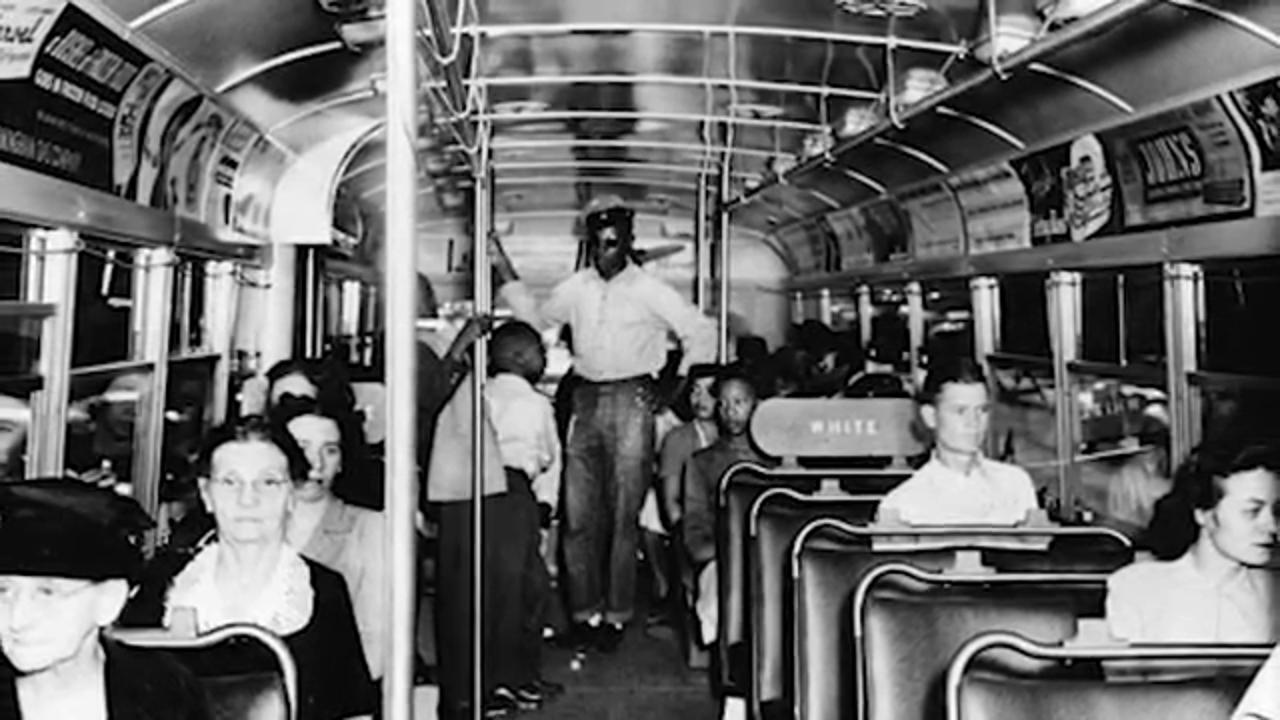
On March 2, 1955, 15 year old Claudette Colvin was riding home from school on a public bus in Montgomery Alabama.  White people sat in the front seats while "colored" people as they were called at the time had to sit in the back.  Ms. Colvin dutifully took her seat in the back of the bus, near the front of the colored section.  However, as the bus made its rounds, the bus began to fill up.  In such cases, the white section got pushed further back to make more seats available for white passengers.  Black passengers would have to give up their seats and stand.  Even more obnoxious in this case, there was an empty seat across the aisle from where Ms. Colvin was sitting. A white passenger had sat down there and everyone was seated.  But the law prevented colored passengers even from sitting in the same row as white passengers.  Colvin essentially had to give up her seat so that it could remain empty, simply because a white woman had sat down in the same row.

The bus driver demanded Colvin give up her seat.  She refused saying "It's my constitutional right to sit here as much as that lady. I paid my fare, it's my constitutional right."  In a later interview with Newsweek magazine, she said:  "I felt like Sojourner Truth was pushing down on one shoulder and Harriet Tubman was pushing down on the other—saying, 'Sit down girl!' I was glued to my seat." Colvin had been on the bus with several of her friends.  Apparently, all but one of them obeyed the bus driver's orders.  The other friend remained seated next to Colvin until the police arrived, then lost her nerve and obeyed the police order to get out of the seat.  At that point, Colvin was alone.

Many years later, Ms. Colvin described her arrest in another account:

"Well, they asked me to get up, and I refused. And one of the policemen was a traffic policeman at Court Square. And he yelled to the bus motorman that he had no jurisdiction here, and he got off. So the bus driver moved the bus to Bibb and Commerce, and then two squad car policemen came on the bus. And they—I became more defiant. And when they asked me the same question, and the gal, "Why are you sitting there?" I said, "It’s my constitutional right. I paid my fare; it’s my constitutional right." And he said, "Constitutional rights?" And then one kicked at me, and when one—and he knocked the books out of my hand—out of my lap. And then one grabbed one arm, and one grabbed the other, and they manhandled me off the bus. And after I got into the squad car, they handcuffed me through the window and took me to booking and then to—not to a juvenile facility, but to an adult jail. And I stayed in jail three—approximately three hours, until my pastor, Reverend H.H. Johnson, and my mother came and bailed me out."

According to the police, she struggled against their attempts to arrest her.  She kicked and scratched the officers.  You can read the arresting officers' account in the original arrest record.    She was charged, not only with violating segregation laws, but also misconduct and resisting arrest.  She was tried as a juvenile, found to be a juvenile delinquent, and put on probation.

By all accounts, Colvin's decision to resist was a spontaneous one.  She had been learning about the growing resistance to the racial injustice in Montgomery's African-American Community.  In some of her accounts she alludes to the fact that her school had just finished black history month (yes, some places had that even in the 1950's) and that she was inspired by those stories.  Her reaction that day though, seemed to be one made without much forethought.

A segregated bus in Montgomery, Alabama
The African-American community was rallied by this injustice and began to hold meetings as people tried to decide how to react.  There was some discussion of a bus boycott and the local NAACP chapter considered bringing a civil suit.  In the end though, they decided that Colvin would not make a good public face for the issue.  There are a variety of reasons given by different people.  Some said that she looked "too black" and that it would be better to have a lighter skinned more attractive woman as the poster child of this injustice.  Some argued that as a teenager, she might not be up to all of the controversy she would have to face.  Some were concerned about the fact that she had apparently fought the police and might be seen as a violent, out of control teenager.  In a later interview, Ms. Colvin commented "I knew why they chose Rosa. They thought I would be too militant for them. They wanted someone mild and genteel like Rosa." A few months after the incident, Ms. Colvin, still a teenager, became pregnant, allegedly from a married man.  That seemed to settle the matter. Her personal story now seemed just too scandalous.

Nine months later, in December 1955, Rosa Parks was arrested for the same offense.  Ms. Parks was a lighter skinned woman deemed more attractive and an adult who could manage herself well in the spotlight.  She was an employee of the NAACP and some argue that she deliberately provoked police into arresting her so she could be the flash point of a real challenge to the law.  I think provocation is a strong word.  It seems Ms. Parks, who rode the bus to and from work, sat at the front of the "colored" section of the bus when possible, and probably resolved ahead of time that if asked to move she would refuse.  But resolving to refuse an unconstitutional order is not provocation.  It is simply standing up for one's rights.  By the time of Ms. Parks' arrest, the African-American community was organized and ready to begin the now famous bus boycott.  Rosa Parks became the poster child and a young Montgomery pastor named Martin Luther King Jr. began a civil rights movement.

Claudette Colvin's story, however, did not end with Rosa Parks' arrest.  Lawyers on behalf of Parks filed suit in Alabama State Court.  It appeared that the State judiciary was going to drag out the case forever so that it would take years to get either a positive resolution or a final decision that could be appealed to federal court.  As a second option, lawyers representing Claudette Colvin and three of her friends from the bus that day filed suit directly in federal court.  That case, decided by a three judge panel in district court found Alabama's bus segregation laws unconstitutional  A few months later, in December 1956, the Supreme Court refused to overturn that finding, making the decision final.  Days later, Montgomery began to allow all riders to use buses on a non-segregated basis and the boycott ended.  It was Colvin's case, not Parks' case, that ended bus segregation in Montgomery.

Claudette Colvin was active in the NAACP, but like many black activists, she was seen as a trouble maker by the white community and could not find work in Alabama.  In 1958, at age 18, she moved to New York City where she eventually found work as a nurse's aide in a Manhattan retirement home.  She worked there for the next 35 years, with few of her coworkers knowing about her civil rights record.  Although she is retired now, Claudette Colvin still lives in New York City.

Listen to a podcast of this episode.

Further Reading

https://kinginstitute.stanford.edu/king-papers/documents/arrest-report-claudette-colvin

http://kingencyclopedia.stanford.edu/encyclopedia/encyclopedia/enc_browder_v_gayle/

http://www.democracynow.org/2013/3/29/the_other_rosa_parks_now_73

http://www.biography.com/people/claudette-colvin-11378

http://www.npr.org/sections/codeswitch/2015/02/27/389563788/before-rosa-parks-a-teenager-defied-segregation-on-an-alabama-bus

https://www.youtube.com/watch?v=pW80tV31eL0


Saturday, January 30, 2016

The History of Primaries and Caucuses

Listen to a podcast of this episode.

It is a well established tradition that becoming President requires campaigning in early caucus and primary states such as Iowa and New Hampshire.  All presidential candidates head out to the early States to garner support.  But this was not always the case.  In fact, selecting Presidential candidates this way is a relatively new process.  For most of US history, there were no primary elections.  They did not become the primary selection method until less than 50 years ago.

Early Elections

The Constitution says nothing about political parties, primaries, anything else about how one gets to be a candidate for President.  The nation's founders, in fact, despised political parties.  They saw them as dangerously creating divisive factions in the country.  They were not wrong on that point.

But by the time Thomas Jefferson became President in 1801 though, the country was well on its way to having two established political parties.  Even so, they still had no established method for a party to choose its candidates.  Members of Congress and State government leaders informally decided among themselves who should stand as the Party's candidate.  Often, State legislatures would nominate a local candidate.  For example, Andrew Jackson started his 1828 campaign by being nominated by the Tennessee legislature.  It was also considered taboo for a candidate to seek the nomination himself.  Doing so smacked of being power hungry and therefore a possible threat to the Republic.  Such a candidate might try to make himself King.  Nominations and campaigns were run through proxies.  Candidates spoke little if at all themselves during the campaign.

The First Conventions

By the 1820's the informal selection process became too unwieldy.  In September 1831, the first National  political convention took place in Baltimore.  Like many political innovations, this convention was the creation of a minor party.  The "Anti-masonic" party which opposed the influence of the Masons in government, met at a national convention to select a candidate for the 1832 elections.  Only 10 States out of 24 even sent delegates, with 96 in total attending.  They selected William Wirt, who ironically had once been a Mason.

Only a couple of months later, the "National Republican" party, a forerunner of the Whig party met, also in Baltimore to select someone to run against Democratic President Andrew Jackson.  Only 18 of the 24 States bothered to send 135 delegates.  They selected Henry Clay, who had stood as a candidate in the 1828 elections as well.  Clay did not need a Convention to get the party behind him.  His nomination was obvious before the Convention started. The convention served as a tool to energize party leaders and make the process a little more transparent.

That same campaign season, in May 1832, the Democratic Party also held its first national convention, also in Baltimore. The city of Baltimore was popular mostly because it was close to DC, since most delegates were members of Congress.  DC itself did not have many large non-governmental buildings at the time to serve as convention halls.  Baltimore was also a relatively central location between the northern and southern states.

Since Andrew Jackson was running for a second term, the nomination was a foregone conclusion. The main purpose of the Convention was to select a new Vice Presidential candidate.  The incumbent Vice President John C. Calhoun, had proven not to be a team player with the Administration.  The Convention selected New York politician Martin Van Buren to run with Jackson on the Democratic ticket.

National Conventions caught on in a big way, held every four years by the major parties, and most minor parties as well.  They quickly became a fundamental part of the campaign process. But there was still no established way to select delegates to the convention.  For the most part, delegates were political and party leaders meeting to work out a deal.  In some cases, they simply showed up themselves at the convention.  In other cases, they were selected by local party leaders or by local State conventions, which again were simply gatherings of local politicians and party leaders.

The First Presidential Primaries

Political primaries, that is actually holding an election to pick convention delegates was a 20th century invention.  Florida passed the first Presidential primary law in 1901, to be used for the 1904 elections.  The innovation took off relatively quickly.  By the 1912 elections, most States had some sort of election process in place to select delegates.  Many Primaries served as statewide polls that just gave input to party leaders on voter preferences.  In most States the political parties ran the primaries without State governments playing any role in the process.

Over the next few decades, not much happened with primaries.  Some states even abandoned them citing high costs and low voter participation.  Party bosses remained in control of the nominations and voters did not see the primary votes as more then window dressing.

It was not until after WWII that primaries began to play more of a serious role in Presidential elections.  Sen. Estes Kefauver (D-TN) entered all 15 primaries held in 1952, winning 11 of them.  He hoped that his primary success would convince political bosses to hand him the nomination. His early wins did convince President Truman not to seek a third term.  However, the political bosses were not impressed and nominated Adlai Stevenson, who was in turn trounced by Dwight Eisenhower.  Primaries still remained relatively unpopular.  Political bosses controlled who the nominee would be.

Primaries could sometimes have an influence.  For example, John Kennedy proved he could win southern Protestant support, despite being a Catholic, by entering and winning the West Virginia Primary in 1960.  Even so, despite winning 10 of the 14 primaries held that year, Kennedy almost lost the nomination to Lyndon Johnson who had not entered nor won a single primary.

The Disaster of 1968

The real changes came after the 1968 elections.  The 1968 Democratic Convention in Chicago was an unmitigated disaster.  New Hampshire, one of the few primary States, handed incumbent President Lyndon Johnson a very disappointing result.  Shortly after that, Johnson decided not to run for reelection, throwing the field into chaos.  Robert Kennedy entered the race as a favorite, only to be shot and killed in June while campaigning.

The party became hopelessly fractured.  There was already a rift between the civil rights position of northern Democrats and the segregationist southern Democrats. If that was not enough, young people were strongly opposed to the war in Vietnam and wanted a peace candidate.  The political bosses got behind Vice President Hubert Humphrey as the Convention nominee.  Humphrey, who had not won a single primary, had recently voiced some opposition over the War, but had largely supported the Administration's Vietnam policies over the prior four years.  Peace activists were not happy and protested the convention.  When the Chicago police used violence, captured on national television, to suppress the protests, an internal civil war broke out in the convention itself.

Humphrey left the Convention as a weak candidate opposed by much of his own party.  Young people opposed to the war either voted Republican or stayed home.  Southerners, opposed to Humphrey's support of Civil Rights, voted for southerner George Wallace.  The result was an easy and overwhelming victory for Republican Richard Nixon.

Modern Era Primary Reforms 

In the wake of this disastrous defeat, the Democrats decided to introduce some major reforms. Although many of these reforms impacted how the conventions would be run, they also stressed the importance of taking into account primary results in selecting the nominee.  State delegations had to be selected by primary or some other process that was open to all members of the State party.  If party bosses ignored the wishes of the voters, that would only need to further losses in the national elections.  Primaries were seen as a way to guarantee popular support.  All fifty States held a primary or caucus in 1972 for the first time.

Despite the increased participation, the party remained hopelessly divided in 1972.  George McGovern won the most State primaries, while Humphrey won the most primary votes overall.  Party bosses deeply opposed McGovern, who had been in charge of many of the reforms that helped him ultimately win the election at the divided Convention.  Without the enthusiastic support of party leaders, McGovern went on to hand the Party its worst loss in history, up until that time.

With all the States holding Primaries, there were more efforts to organize their scheduling.  New rules required that all States hold their elections between March and June of the Presidential election year. Two exceptions were made for the Iowa caucuses and the New Hampshire Primary, which were permitted to earlier contests

The Iowa Caucus

Iowa became first mostly by accident.  It retained a caucus rather than a primary. After the 1968 elections, party rules required that all aspects of candidate selection be opened to all members of the party. Iowa had a four part selection process.  There had to be a precinct caucus, which selected delegates to a county convention, which in turn sent delegates to a district convention, which then sent delegates to a State convention, which would in turn select delegates to go to the national convention.  There had to be at least a 30 day period in between each step of the process.  This meant the precinct caucuses had to be held in February at the latest in order to have delegates at the national convention in July.  To ensure proper time, the Caucuses for 1972 were held in late January.

They were so early that year, that few people in the press even paid much attention.  The candidates mostly ignored Iowa in 1972 and it was a non-event nationally.  All that changed, however, in 1976. A young relatively unknown Governor named Jimmy Carter decided to run for President.  In 1973, he appeared on the Game Show "What's My Line?"  No one on the panel could guess who he was or what he did for quite some time.  He was really unknown.

Carter completed his single term as Governor of Georgia in January 1975.  He had already begun making plans to run for President.  As a relative unknown, he decided that if he could win the Iowa Caucus, that would give him the national recognition he would need to continue on through the process to the nomination.  As a result, Carter spent most of 1975 in Iowa meeting with locals and talking about what he would do as President.  Since no other candidates were in Iowa, Carter was able to win over support one voter at a time.

The strategy worked.  Carter won more votes than any other candidate in a wide open field, garnering 27% of the vote.  The next highest candidate, Birch Bayh received less than half that, 13%.  Of course "uncommitted" won the race with 37%.  But the fact that an unknown southern former Governor could win the State, set off a press frenzy around the Carter campaign.  It gave him the national recognition he needed to win the future primaries, the party nomination, and eventually the White House.

Following the 1976 elections, all serious candidates have made at least some effort to make a good showing in Iowa.  Although the Iowa Caucus does not often pick the candidate who ultimately wins the nomination, It has become the de facto process for winnowing down the field.  If you don't finish in the top three in Iowa, your campaign is pretty much over. Only one candidate has ever gone on to win the nomination after a fourth place finish in Iowa (John McCain in 2008).  Technically, I suppose, Bill Clinton finished fourth in 1992, behind two other candidates as well as "uncommitted". But he was running against an Iowa Senator (Tom Harkin).  Since Harkin would presumably win his home State, Clinton did not spend much time there.

New Hampshire Primary

New Hampshire had been one of the few primary states long before the 1968 reforms.  It has held a Presidential primary since 1916.  Beginning in 1920, it became the first primary for the election year. For many years, this was simply the way things worked out.  Most States did not have primaries. Those that did usually had them in late spring or early summer.  New Hampshire soon realized that being first meant that it got noticed more.  The State eventually passed a law requiring that the State hold the first primary in each Presidential election.  The primary, once held in mid March, eventually got pushed back to early February, and sometimes late January, in order to be first.

The 1968 reforms recognized New Hampshire's need to be first and granted the State an exception to the requirement that all primaries be held in March or later.  With this one State exception, it guaranteed New Hampshire continued prominence in the election process.  States have since tried to find ways to push their primaries in advance of New Hampshire, but the Parties have not allowed it. Limits on early primaries too many months before the convention were designed to prevent the campaign process from being stretched over too long a period and allowing for intervening events to make an early choice problematic.  As a result, New Hampshire remains the first primary outside of the main primary season, usually a week or two after the Iowa Caucus.

Later Reforms

Changes have continued as South Carolina has been given "early State" status in order to be more inclusive of Southern voters.  As more and more states want to hold early primaries within the allowed limits the tradition of "Super Tuesday" has arisen on the first Tuesday within the dates permitted by party rules.

You may have noticed that I have primarily focused on the Democratic Party while discussing the development of primaries and caucuses.  The reality is that most of the reforms have been the result of Democratic Party Reforms.  The Republicans have generally followed the same process.  Since State laws instituted primary elections for both parties, both adopted most of the changes at relatively the same time.

Today the primaries and a few caucuses dominate the selection process.  It is almost always the case that a candidate is chosen by receiving enough delegates to secure a majority at the convention long before the convention takes place.  As a result, conventions have largely become attempts by the Parties to advertise themselves, their platform and their candidates.

Both parties have "superdelegates" which is the polite name given to modern day party bosses. These are delegates beyond those chosen in the primaries.  They usually make up elected officials and State party leaders, as well as members of the national Party Committees.  As currently selected, Superdelegates are new.  They are the result of reforms for the 1984 elections after Democratic leaders decided that too much popular input had led to weak candidates in recent elections.  Even so, superdelegates have never rejected the choice of the primary voters.

Conventions Become Irrelevant

Since the 1968 reforms, only one Convention was ever really in question.  In 1976 incumbent President Ford faced a challenge from Gov. Ronald Reagan   Ford had the most primary votes but not an outright majority.  Still, Ford was able to win on the first ballot.  In 1980, Ted Kennedy attempted to take the nomination from incumbent Jimmy Carter, who had won a slim majority of delegates, by trying to encourage delegates to jump ship and oppose the will of the primary voters.  In the end though, Carter was nominated on the first ballot.  In 1984, candidate Walter Mondale was just a few votes short of a majority of primary selected delegates.  But his closest competitor Gary Hart, never mounted a serious convention challenge

In 2008 a close primary election between Hillary Clinton and Barak Obama led to a possible convention fight.  Obama had won a majority of primary votes.  But Florida and Michigan did not receive any delegate votes that year.  Both States had attempted to hold primaries in advance of New Hampshire, in violation of Party rules.  Clinton had campaigned heavily in both States and had won substantial majorities in those illegal primaries.  Clinton argued that the delegates should be given their vote.  Clinton had also secured pledges from a large number of superdelegates.  However, as the primary season came to an end, superdelegates were unwilling to overturn the will of the primary voters and largely defected from Clinton to Obama.  As a result, the nominee was decided before the Convention opened.

 Conclusion

As much as we like to think about our electoral process as a tradition.  A voter from fifty years ago would hardly recognize the primary process today.  A voter from 100 years ago would likely be shocked to see that primaries even play a significant role.  A voter from 200 years ago (still 40 years after the Declaration of Independence) likely would be surprised to see the use of political parties or conventions.  Many of our traditions are younger than most of our senior citizens alive today.  It remains an evolving process with new changes in each election.

Listen to a podcast of this episode.

Further Reading

The First American Political Conventions
http://history1800s.about.com/od/presidentialcampaigns/a/politconvent01.htm

Choosing the Nominee: How Presidential Primaries Came To Be and Their Future in American Politics 
http://scholarworks.wmich.edu/cgi/viewcontent.cgi?article=3291&context=honors_theses

Iowa Caucus Rules
http://www.whyiowa.org/Why%20Iowa%20Chapter%203.pdf

Why is the New Hampshire Primary so Important? 
http://www.beliefnet.com/columnists/news/2012/01/why-is-newhampshires-primary-so-important.php

The Primary Experience: Jimmy Who?
http://www.newyorker.com/news/daily-comment/the-primary-experiment-jimmy-who


Saturday, January 16, 2016

America: Built by Lottery

Listen to a podcast of these episode.

With the recent record $1.6 Billion Powerball lottery over now, I got to thinking about the history of lotteries.  They can be traced back to ancient times, with examples all over the world and throughout most of human history.  Today I thought I would focus on the history of lottery in creation of the United States and its rebirth in modern times.

Lottery to finance Jamestown, Virginia

The first permanent British Colony in America, Jamestown Virginia, relied on financing from wealthy investors, the 17th Century equivalent of venture capitalists.  But the colony was slow to show a profit and investors were loath to continue dumping more of their own money into the venture.  So, the financiers received permission from King James to hold a lottery for The Virginia Company.

The First Great Standing Lottery took place in March 1612. Players could purchase a ticket for 2s. 6d. That is two shillings and six pence. Under the old system of British currency, one pound (£) equaled 20 shillings (s) or 240 pennies (d) - "d" being used from the Latin "denarius".

Tickets were not cheap.  A common laborer would usually earn less than on shilling per day.  But the prizes were also valuable.  The lottery offered a variety of prizes worth a total of £5,000.  These included a "fayre plate" worth £1,000, more than a common laborer would earn in a lifetime.. Still, the lottery was not as successful as hoped.  The drawing which had been scheduled for May had to be postponed until the end of June.  The lottery had not sold enough tickets, in part because of rumors of a fixed result.  In the end, the lottery did help raise desperately needed funds for the colony.

The company held smaller lotteries, known as the "Little Standing Lottery" throughout 1612 and 1613. Tickets were a mere 12d, with smaller prizes .  At the same time, the company started the Second Great Standing Lottery during the summer of 1612, with a hefty 5s ticket.  Ticket sales took over three years, with the drawing finally held on November 17, 1615.

In 1616, the company began "running lotteries." Rather than waiting for a final drawing day, running lotteries allowed people to draw lots which meant they could win a prize immediately or nothing. These were the equivalent of modern scratch off tickets.  The company sent its agents Gabriel Barbor and Lott Peere, travelling throughout the country side to raise money.  The agents got the support of local authorities by providing personal gifts.  Gaining local support was critical to building trust that the games were honest.  Drawings were typically held in the presence of local officials, with a local child pulling the lucky lots.

Many of the details of these local lotteries are not available, but records for a 1618 lottery run in Leicester show the games lasted for six weeks. Players could purchase some of the forty thousand lots were available for sale at 12d. each, with chances to win over 1,500 prizes.  The total value of all lots was £2000, with about half that amount distributed as gifts and prizes.  By one estimate, the company's profit for this one lottery was £961, an amount that would pay for an entire ship's voyage to the new world.

The Virginia Company reported £7,000 in lottery earnings for 1619, the bulk of its total cash on hand in 1620: £9,831.  Clearly lotteries were a profitable business, covering much of the expenses the Jamestown colony that continued to hemorrhage cash.

There were, of course, critics to allowing this private company to raise such fortunes.  Some critics focused on claims of cheating and corruption.  But a prime complaint was simply that wealth was being sucked out of the working poor who could least afford it.

Sir Lionel Cranfield spoke about this in the House of Commons on February 24, 1621: "I am of the Company of Virginia, but I hear these lotteries do beggar [impoverish] every country they come into. Let Virginia lose rather than England."  Public criticism of the lottery grew louder and the King eventually shut down the lotteries.

Colonial Lotteries

Colonial lotteries began to take shape in the mid-1700's.  Massachusetts had already subjected its citizens to heavy poll taxes and estate taxes and was still struggling to pay its bills.  Despite a strong Puritan opposition to gambling of any sort, the Colony decided that it would hold a lottery to raise funds in 1745.

The Colony planned to sell 25,000 tickets at a cost of 30s (£1.5) per ticket.  The lottery would be overseen by a Board of Directors made up of leading figures in the colony: Samuel Watts, John Quincy, James Bowdoin, Robert Hale and Thomas Hutchinson.

Massachusetts Colony lottery ticket.
The process of selection seems rather complicated.  Each player received a numbered ticket, one to keep and one put in a box.  All 25,000 tickets were placed on one box.  25,000 more tickets were placed in a second box.  On drawing day, officials would draw one play ticket and one prize ticket from each box.  If the prize ticket was blank, the player got nothing.  If the ticket contained a prize, officials would write the player's name on a list for payment of the amount won.  This process meant hand drawing all 50,000 tickets to determine the winners, a rather lengthy process.

The total amount collected from the sale of all tickets was £37,500.  Prizes ranged from two top awards of £1250, to 5250 awards of £3,15s (about double your money back).  There were a total of 5422 awards, meaning your chances of winning something was about 25%.  To total amount awarded as prizes was £37,500.  But wait, you may ask yourself.  If total tickets sales was £37,500 and total award money was £37,500, how did they make money?

The answer is with taxes.  Each award came with a 20% tax, meaning the winner only received 80% of the award amount.  Total collections from taxes would be £7,500, minus the costs of running the lottery.

According to the rules set up by the legislature, the lottery, which began selling tickets in January, had to hold the drawing on or before April 9.  However, according to The Boston Weekly Post Boy April 8, 1745, the lottery had to be postponed until June 4th because there were still unsold tickets. Fears grew that the Colony might lose money if it had to pay out awards in excess of the amount collected from ticket sales.

Eventually, however, all the tickets were sold and the lottery drawing was started. The Boston Evening Post of June 10, 1745 mentioned the lottery drawing had begun several days earlier at Faneuil Hall, with the drawing still continuing.  Finally, on June 18, the Boston Gazette reported that the lottery office in Faneuil Hall had a record of all winning ticket numbers.  Anyone could could go to check their tickets.

Lottery Ticket, Signed by George Washington
Despite some trouble with timely ticket sales and the delays in completing the drawing, the lottery was generally considered a success.  It raised needed funds for the colony and people generally seemed satisfied with the fairness of it.  This seemed to be the beginning of lottery fever in the US.  Rhode Island held a lottery later that same year, the first of 82 lotteries that it would hold before the Revolution. Philadelphia held a lottery in 1748.  Soon lotteries became the preferred method of raising money for any public project.  Not all were run by the government.  For example, when George Washington headed a project to build a road in Virginia to a Mountain resort in development, he sold lottery tickets to finance the project.  The lottery itself turned out to be a disaster, but the tickets, with Washington's signature on them, have become valuable collector's items.  Some lotteries from this period even offered slaves as a prize to be won.

Nonexistent a generation earlier, Colonial lotteries popped up almost everywhere.  They financed a wide variety of projects, but also raising societal concerns.  In 1769, King George III outlawed all lotteries that did not have the Crown's explicit approval.  With that approval extremely difficult to obtain, lotteries in the colonies came to a halt.

Lotteries during the Revolution.

Well, the lotteries did not so much come to a halt, more like a short pause.  As the American Revolution got underway in the 1770's, colonies and later States at war with Britain no longer felt constrained by the King's decrees.  Numerous lotteries were commenced to finance the Revolution. Benjamin Franklin organized a lottery in Philadelphia to pay for canon.  In 1776, the Continental Congress attempted a $10 million lottery to help finance the war, though the project ended up floundering and was never completed.

As taxes were highly unpopular and often impossible to collect, lotteries became a good way of collecting money from the common population.  Alexander Hamilton, summed up the age old appeal of lotteries: “Everybody … will be willing to hazard a trifling sum for the chance of considerable gain … and would prefer a small chance of winning a great deal to a great chance of winning little.”

Early US lotteries

States continued to hold lotteries and allow private lotteries in some cases in the newly formed United States. Lotteries often supported special projects such the building of canals or public buildings. Some supported universities.  Thomas Jefferson received permission from Virginia to hold a private lottery late in his life in order to pay off some of his personal debts.  Although he died before the lottery could be held, it was eventually completed by his estate.

The federal government made no attempt to restrict lotteries.  In fact, it organized a few of its own. Congress created a national lottery to help pay for construction in the District of Columbia.  In fact, one of these resulted in a US Supreme Court case after Virginia tried to bar the sale of federal lottery tickets within the State.  Virginia wanted to retain a monopoly on lotteries.  The Court in Cohens v. Virginia (1821) sided with the State, holding that Congress had never intended the sale of tickets outside of DC.

Lotteries fall out of favor

Then, in the 1830's public opinion began to turn against lotteries. Several lottery scams helped turn public opinion against gambling.  Traditional religious opposition to gambling, combined with social reform movements that saw the cost of gambling with no real societal benefit caused many leaders to decide it was a harm to society that needed to be abolished.

In 1833, Pennsylvania, Massachusetts and New York banned all lotteries.  Other States soon followed.  By 1860, only three states still permitted lotteries: Delaware, Missouri, and Kentucky. Although it was illegal, many enterprises sold lottery tickets for these States throughout the country. After the Civil War, a federal law made it illegal to use the US mail to distribute lottery tickets.

But the reconstruction years were hard times.  In 1868, the Louisiana legislature was desperate for money.  Its notoriously corrupt legislature made a deal with a criminal syndicate from New York to create a State lottery with a 25 year charter, and establishing the syndicate as the sole lottery provider. The Louisiana Lottery became wildly popular throughout the country, despite restrictions on using US mail.  About 90% of its revenues came from out of state sales.  Louisiana soon became the only legal lottery in the US.  Finally in 1895, Congress barred any transmission of lottery tickets across State lines by any means.  With out of state sales becoming impossible, the Louisiana lottery was abolished.

With the death of the Louisiana Lottery, all States had outlawed lotteries.  Many had added such prohibitions to their State Constitutions.  For nearly three generations, Americans would not have any options to play the lottery legally anywhere in the US.

While legal lotteries disappeared, gamblers turned to organized crime for their lottery fix.  The "numbers racket" grew increasingly popular in many cities.  Most of these operated much like the daily lotteries run by States today.  A random three digit number would give a pay out, usually of 600 to 1.  Because no one trusted criminal syndicates to pick the numbers, and because they could not be picked in a public drawing, groups used relatively random numbers as the award.  One group, for example, used the last three digits of the published balance of the US treasury.  Another, used the last digit of dollar pay outs for win, place, and show for a particular local horse race.  These methods generated random three digit numbers that no one could easily manipulate.

Other Americans turned abroad.  The Irish sweepstakes began in 1930.  It derived most of its revenue from US purchases.  The importation and sale of such tickets in the US was illegal.  Nevertheless, the Irish Sweepstakes became wildly popular for many years.

Rebirth of the State Lotteries

Legal US lotteries remained nonexistent for decades.  Then, in 1964 New Hampshire decided to create a State lottery.  The age old desire to raise money without raising taxes make the lure of the lottery too tempting.  New Hampshire had no income taxes nor sales taxes and needed revenue.

NH Gov. John King purchases the first
legal lottery ticket of the 20th Century
(1964)
This, however, was not a simple task. In addition to the many State laws nationwide, there were numerous federal laws designed to prevent lotteries.  US officials did not want a replay of the Louisiana Lottery of the previous century where one state benefited from a lottery at the expense of all the others.  Not only were there federal laws against using the US mail to distribute any information related to lottery, but any interstate transportation of anything lottery related was banned.  This included restrictions on newspapers that carried lottery results, or announcement of any lottery information via TV or radio, and other criminal statutes that made it virtually impossible to create a working lottery.

New Hampshire attempted to avoid some of the anti-lottery laws by calling the new game a sweepstakes.  Winning numbers would be tied to random numbers generated from local horse racing results inside the State.  The State had to pay onerous excise taxes to the Federal government, designed to discourage such gambling.  All sales were done in state, mostly in liquor stores.

Nevertheless, the games enjoyed great popularity.  Tickets cost $3 for a chance to win up to $100,000.  Despite the strict bans on interstate transport of lottery materials or advertising, most tickets were sold to out-of-state customers from New York, Massachusetts, and elsewhere.  The most popular sales outlets sat right at the State border, where travelers could travel to buy their tickets.  New Hampshire tourism revenues boomed as many people traveled to New Hampshire primarily to buy lottery tickets as part of a longer vacation. The game was an overwhelming success.

Nationally, public opinion began to turn quickly.  There were still critics of this new legalized gambling which was not only permitted but encouraged by the government.  Many, however, saw the new lotteries as a way to take the numbers racket away from organized crime.  It also quickly became a tempting source of revenue to State officials.  Neighboring States began to develop lotteries of their own.  The New York Lottery began in 1969.  New Jersey followed in 1970.  Massachusetts began a scratch off game in 1974.

These new State lotteries created difficulties for federal officials since many of them seemed to be run in violation of federal anti-lottery laws.  In 1974, the Department of Justice considered criminal prosecution of some state officials whose lotteries were flouting federal law.  But popular opinion seemed squarely in support of State lotteries. Congress amended federal laws to exempt state run lotteries from federal anti-gambling laws generally.  With these changes to the law the DoJ dropped its investigations.

With the federal government no longer restricting them, lotteries grew and expanded at an accelerated rate.  New Hampshire, Vermont, and Maine formed the first multi-state lottery in 1985 in order to offer bigger jackpots and compete with lotteries in larger States.

Today, lotteries are nearly universal, 44 of 50 States have a State lottery.  Only Alabama, Mississippi, Utah, Nevada, Alaska and Hawaii don't have a lottery.  Multi-state games such as Powerball or Mega Millions have become billion dollar industries.  Lotteries enjoy massive popularity and appear to be here to stay.

Listen to a podcast of these episode.

Further Reading:

http://www.encyclopediavirginia.org/Virginia_Company_of_London - Early lotteries supporting the Jamestown colony.

http://www.coins.nd.edu/ColCurrency/CurrencyText/CLT.html - Early Colonial Lotteries.

http://www.naspl.org/index.cfm?fuseaction=content&menuid=11&pageid=1016 - History of Lottery Timeline.

http://scholarship.law.cornell.edu/cgi/viewcontent.cgi?article=4158&context=clr0 - Cornell Law Review Development of the Federal Law of Gambling (1978).

https://books.google.com/books?id=mm25CgAAQBAJ - eBook American Sweepstakes by Kevin Flynn (2015)

Saturday, January 2, 2016

Submarine Warfare in the American Revolution

Listen to a podcast of this episode.

Most people think about submarine warfare beginning with the WWI German U-boats.  But military inventors have been looking for ways to use the cloak of underwater travel for centuries.

The American Revolution saw submarine warfare, although it is not widely remembered as it was not a success.  Still, I think it is an amazing example of the daring and ingenuity of the men who fought that war.
Artist's rendering of
Bushnell's Turtle

In the summer of 1776, the British fleet arrived in New York Harbor.  The Americans had no real navy at the time, certainly nothing that could challenge the British.  They were looking for an effective way to attack.

David Bushnell was a recent graduate of Yale College.  While at school, Bushnell worked at developing ways of exploding gunpowder underwater.  While underwater explosives are taken for granted today, the ability to ignite a device under water that had to stay dry and needed oxygen in the air to explode properly was quite a challenge at the time.  Bushnell was able to develop some effective underwater explosives during his time at school, a project that would likely be widely frowned upon at most colleges today.

Still getting the explosives to the the ships where they could do damage seemed an impossibility. Guards aboard ship would spot any vessel approaching a warship.  They could raise an alarm and fire on any ship before it could get close enough to explode any device.  No surface ship could approach a naval vessel, even at night.

Building the Turtle

David Bushnell and his brother Ezra, as well as a local artisan named Isaac Doolittle began work on a delivery device that could travel under water.  They made the vehicle out of oak, held together with iron hoops like a barrel. To travel underwater, they developed what they called a "windmill propeller" but is actually a forerunner of the modern screw propeller that others claimed to have invented half a century later. They used a hand crank and foot treadles, similar to what was used with other machinery of the time, to turn the propellers.

Snorkels supplied air for the pilot, meaning that the vessel would have to travel near the surface for most of the trip, then rely on the air inside the small operator area when descending near the target. Similarly a small window in the top hatch provided light when on or near the surface, but no light was available during the descent.  The pilot controlled descent underwater by allowing water into the bottom of the vessel, around the pilot's feet.

A small team built an underwater mine, containing about 150 pounds of black powder.  A screw would allow it to be attached to the bottom of a ship.  Doolittle, who was a clock maker by trade, developed a timing device that would allow the pilot to trigger the device then have a few minutes to escape before a flintlock from a gun fired a spark into the gunpowder to trigger the explosion.

The team tested the vehicle, named the Turtle for weeks on the Connecticut River.  Ezra Bushnell, David's brother, served as the pilot.  The plan was to propel the Turtle along the surface at night until it got close to a ship.  Then, it would descend underwater, where the pilot would attach the explosive to the bottom of the ship with a screw, set the timing device, and move away before the explosion. With the British fleet in New York Harbor, the team selected Admiral Howe's flag ship, the HMS Eagle as the target.

The Attack:

Execution of the plan, however, ran into numerous problems.  First the pilot Ezra Bushnell became feverishly ill and was not fit for duty.  A new pilot, Ezra Lee had to be trained, taking several more weeks.  Eventually the team brought the Turtle to New York Harbor.  Lee describes his attempt to reach the enemy ship: “We set off from the City, the Whale boats towed me as nigh the ships as they dare go, and then they cast me off. I soon found that I was too early in the tide, as it carried me down to the [transport] ships. I however, hove about, and rowed for 5 glasses [2½ hours], by the ship’s bells, before the tide slackened so that I could get along side the man of war, which lay above the transports.”

By this time, it was close to dawn and Lee was exhausted.  Still he descended underneath the ship and attempted to attach the explosive.  “When I rowed under the stern of the ship, could see men and deck and hear them talk-then I shut all doors, sunk down, and came up under the bottom of the ship, up with the screw against the bottom but found that it would not enter.”  Sadly for the American effort, the Eagle had a copper cover underneath the ship to prevent barnacles from attaching and slowing down the vessel.  The Turtle's screw was designed to bore through wood, but could not pierce the metal.

Now daylight, Lee decided to make his escape before being discovered.  The British saw the vessel and sent several guard boats after him to discover what this was.  Lee detached his explosive and set the timing device, hoping to take out his pursuers, and possibly himself as well.  He “let loose the magazine in hopes, that if they should take me, they should likewise pick up the magazine, and then we should all be blown up together…”   The explosion was not near enough to any vessels to cause any damage, but the distraction was enough to allow Lee to make his escape and reach the shore.

Later Efforts:

The patriots recovered the Turtle and prepared for a second attempt further up the Hudson river.  The British, now alerted to the danger, discovered the vessel on two subsequent attempts to make contact with the enemy and fired upon it.  In both cases, the pilot was able to make his escape, but without being able to attach the explosive.  Shortly after this, the British nave sank the transport vessel carrying the Turtle.  With the loss of the vessel after three unsuccessful attempts, the Patriot submarine project came to an end.

David Bushnell went on to develop several under water mines that were used against British ships. In 1777 he attempted to use a floating mine to blow up the HMS Cerberus near New London Connecticut. The mine struck a smaller boat near the Cerberus.  The explosion killed four enemy four sailors and destroyed the boat.  The Cerberus, however, escaped.  In 1778 Bushnell floated several mines down the Delaware River to attack anchored British ships.  The mines missed their targets, but killed two young civilians.

Bushnell's Career

David Bushnell
Despite a lack of any real success, the Continental Army continued to see potential in Bushnell's efforts.  In 1778, General Washington proposed the formation of a new military unit to be known as the "Corps of Sappers and Miners".  Bushnell was given command of the Corps in 1779.  Near the end of the War in 1783, he became Commander of the Army Corps of Engineers as West Point.  There, he continued his work developing new technology for the Army.

After the war Bushnell left the military.  He spent several years in France.  Eventually he returned to the US, setting in Georgia where he worked as a college professor and medical Doctor.  For unknown reasons, he had changed his name to David Bush.  He never married or had any children.  He also continued to work on underwater explosives and delivery devices later in life as well.  He was still seeking a new contract with the US Army shortly before his death in 1824.  A model torpedo was found among his possessions after he died.

Legacy:

The project remained a military secret throughout the war.  It did not become generally known until Thomas Jefferson gave a lecture on the subject to the American Philosophical Society in Philadelphia in 1798.  Bushnell had corresponded with Jefferson about the military venture after the war had ended.  Submarine warfare, however, was shelved.  The US Navy would not commission its first submarine until more than a century later.

Honored as the father of Submarine Warfare, the US Navy has named two ships USS Bushnell, one in operation during WWI and a second in WWII.

Listen to a podcast of this episode.

Further Reading:

http://connecticuthistory.org/david-bushnell-and-his-revolutionary-submarine

http://biography.yourdictionary.com/david-bushnell

http://www.navsource.org/archives/08/08441.htm

http://turtlesubmarine.umwblogs.org/david-bushnell

http://www.breedshill.org/The_Breeds_Hill_institute/Turtle_Model_files/American%20Turtle%20Book.pdf